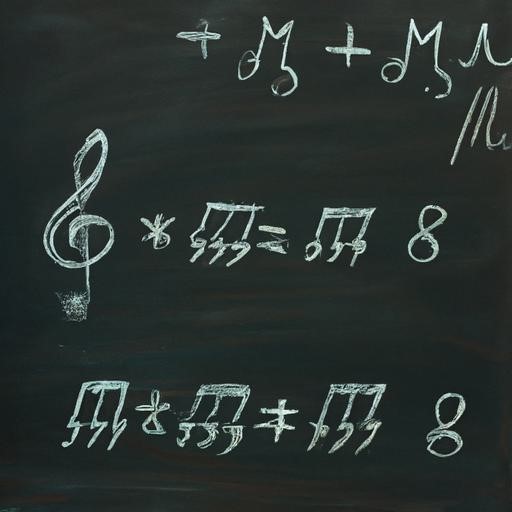
Music and mathematics are closely interconnected, as both involve patterns, structures, and relationships. Here are some mathematical structures found in music:

1. Ratios: Musical intervals are often expressed as simple ratios. For instance, the octave (the distance between one musical note and the next one with the same name) is expressed in a 2:1 frequency ratio. The perfect fifth has a 3:2 ratio, while the perfect fourth has a 4:3 ratio. The use of ratios corresponds directly with the concept of fractions in math.

2. Pythagorean Tuning: Named after the famous Greek mathematician Pythagoras, this tuning system also uses ratios. Pythagoras discovered that vibrating strings produce harmonious sounds when the ratios of the lengths of the strings are whole numbers.

3. Fibonacci Sequence and The Golden Ratio: The Fibonacci sequence (1, 1, 2, 3, 5, 8, 13, 21...) and the golden ratio (around 1.618) show up in various aspects of music. In music composition, the structure of phrases or the organization of large-scale works often reflect these mathematical patterns.

4. Geometry: The circle of fifths, which is a fundamental concept in music theory, can be represented geometrically in the form of a circle.

5. Trigonometry: Sound waves themselves can be described using functions from trigonometry. The simplest kind of sound wave, a sine wave, corresponds to a pure musical tone.

6. Algebra: The twelve-tone technique, developed by composer Arnold Schoenberg, applies algebra to construct musical sequences.

7. Number Theory: This applies to rhythm and meter in music. The time signatures in music often contain powers of 2, like 2/4, 3/4, 4/4, 6/8. Complex rhythms may involve other numerical relationships.

Thus, mathematics can offer tools for understanding the complexity and beauty of music, and music can give insight into the aural application of mathematical concepts.
Written by OpenAI GPT-4


 Realizing News
Leave a comment