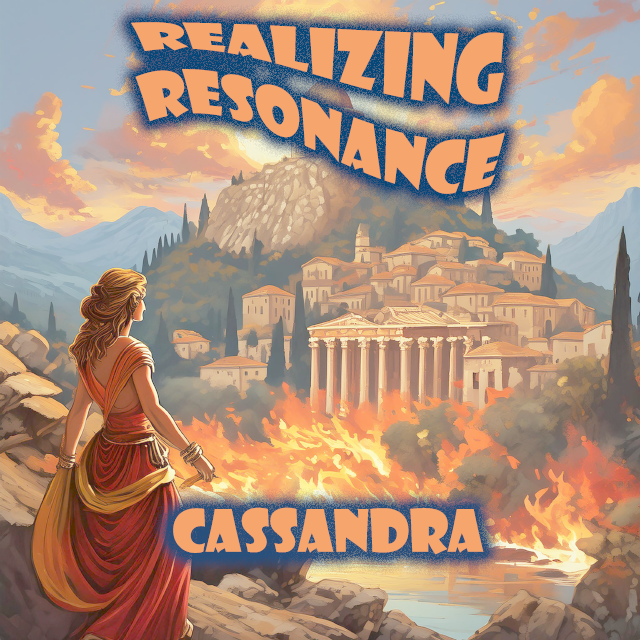
I had the idea to write a song about Cassandra for a long time. In my day job I am a Data Scientist and I have spent about two decades making forecasts and predictions. The Greek Myth of Cassandra is fascinating for forecasters, because Cassandra was given the gift of perfect foresight by the God Apollo, but also cursed by him to never be believed. When she warned her fellow citizens of Troy that their legendary city would fall, they thought she was a madwoman, and the rest is history.
The lesson the myth of Cassandra teaches is that credibility is more critical than accuracy for those making predictions, as the utility of predictions comes only in their advance warning and the actions that result from this. There is another philosophical lesson here about the futility of changing the future when your predictions are ensured to be perfectly accurate, as this entails a paradox. Foreknowledge ceases to be foreknowledge when the future it anticipates is avoided because of that foreknowledge.
Cassandra is a cursed, doomed, and tragic figure, which is what makes her so sympathetic. We know she was right, at least according to the myth. She predicted the fall of Troy and it fell. We know she was right because we are in her future with the benefit of perfect hindsight.
As I was thinking about how to turn the story of Cassandra into a song, it occurred to me that an incredible number of songs titled by a woman’s name are love songs. Just to name a few, there is ‘Peggy Sue’, ‘Donna’, ‘Angie’, ‘Michelle’, ‘Amanda’, ‘Layla’, ‘Gloria’, and so many more. This got me wondering who might fall in love with Cassandra. Perhaps someone from her future…
After writing my song ‘Cassandra’ last year I was excited to see when Taylor Swift released a song called ‘Cassandra’ on The Tortured Poets Department Anthology. Then I found out that Florence + The Machine also have a song with the same name. These other two songs are in fact referencing THE Cassandra from Greek myth. Given the popularity of our subject I thought it would be fun to have AI analyze the lyrics of these three different songs called ‘Cassandra’ to compare them.
AI Lyrics Analysis of ‘Cassandra’ by Florence + The Machine
“Cassandra” by Florence + The Machine is a deeply introspective song with a rich veil of symbolism derived from the Greek myth of Cassandra, a princess of Troy who was cursed with the ability to foretell the future, but no one would believe her prophecies. The song poetically explores the themes of disillusionment, loss of faith, individual struggle, creative crisis, and self-rediscovery.
In the opening lines, the singer refers to Cassandra’s myth, symbolizing the loss of her personal ability to foresee or control her life (“I used to see the future and now I see nothing / They cut out my eyes and sent me home packing”). The phrase “Crying like Cassandra” indicates a sense of frustration and struggle since, like Cassandra, her warnings or expressions (whether in the form of prophecies or songs) are not taken seriously or are misunderstood.
The lyrics “All the gods have been domesticated / And Heaven is now overrated” signify disillusionment with religion or higher powers. The statement “the churches, they all closed their doors” further emphasizes the feeling of being abandoned or neglected either by society or a higher power. Moreover, the lost faith isn’t simply in religion but also in art (“Every song I thought I knew, I’ve been deafened to And there’s no one left to sing to”), implying a sense of creative crisis.
The chorus, “Well, can you see me? I cannot see you/ Everything I thought I knew has fallen out of view / In this blindness I’m condemned to”, reflects the feelings of isolation, confusion, and the fear of unknowing, as well as a longing for connection and understanding.
Further, the bridge lyrics “Oh, drunken gods of slaughter / You know I’ve always been your / Favorite daughter” are likely a chastising comment on the capriciousness of the gods (possibly referring to Greek mythology), suggesting that even their favorite is subject to their cruel whims. The song seems to conclude with a hopeful note, indicating the singer’s desire for change and freedom, even if it leads to destruction (“And if I run fast enough, could I break apart As empires crumble and cathedrals flatten in my heart?”).
Overall, the song’s layered and philosophical themes, notwithstanding its connection with the harsh destiny of Cassandra, resonate with emotions that drift between hope, despair, frustration, and longing for understanding and meaningful creative expression.
Read the lyrics at Musixmatch: https://www.musixmatch.com/lyrics/Florence-The-Machine/Cassandra
AI Lyrics Analysis of ‘Cassandra’ by Taylor Swift
The song “Cassandra” by Taylor Swift seems to draw inspiration from Greek mythology and the story of Cassandra, a prophetess who was cursed to have her true prophecies disbelieved. The lyrics depict the singer in her new house, reminiscing about the moment she received a significant phone call.
The song explores themes of betrayal, persecution, and the struggle to be believed. The narrator compares herself to Cassandra, emphasizing the unjust treatment she has endured for speaking the truth. In Greek mythology, Cassandra was not believed by her community, even though her prophecies were accurate. Similarly, the singer expresses frustration that her warnings and revelations have been ignored, resulting in personal hardship.
The lyrics further touch upon the intertwining concepts of vulnerability and strength. The singer weaves nightmares in her tower, symbolizing the emotional toll of her experiences. She questions whether surviving difficult circumstances ultimately shapes one’s identity. The line “What doesn’t kill you makes you aware, what happens if it becomes who you are?” juxtaposes resilience and the potential loss of one’s true self.
The chorus emphasizes the tragic fate of Cassandra, as both she and the singer were silenced and subjected to harm for speaking their truth. The lyrics express regret and frustration while urging the listener to reflect on whether they now believe the singer’s words. Throughout the song, there is also an underlying critique of societal silence and complicity. The singer denounces those who were aware of the injustice and deception but chose to remain silent. The line “They knew, they knew, they knew the whole time, That I was onto something” suggests that the singer’s insights and revelations were not hidden but rather ignored deliberately.
In the end, the song reveals a sense of isolation and loss with the repeated line “Not a single word was heard,” emphasizing the marginalization of the singer’s voice. The contrast between the chaos and violence of the world and the subsequent quiet when the truth is revealed alludes to the indifference and apathy that often accompanies exposure of wrongdoing.
As a whole, “Cassandra” portrays a narrative of a person who has been disregarded and misunderstood, drawing parallels to the tragic figure of Cassandra in Greek mythology. The song highlights issues of truth, betrayal, and the struggle to be heard and believed, reflecting the artist’s quest for validation and recognition.
Read the lyrics at Musixmatch: https://www.musixmatch.com/lyrics/Taylor-Swift/Cassandra
AI Lyrics Analysis of ‘Cassandra’ by Realizing Resonance
The song “Cassandra” by Realizing Resonance appears to be about the Greek mythological figure of the same name. In Greek mythology, Cassandra was the daughter of Priam, the King of Troy. She was gifted with the power of prophecy by Apollo, but when she rejected his romantic advances, he cursed her: that no one would ever believe her prophecies.
The first verse refers to Cassandra’s predicament, her futile attempts to change the course of events (likely referring to the fall of Troy), and the scorn and derision she faces due to Apollo’s curse. The phrase “the war can’t be won, prophecy will be done” could refer to her prophecy about the fall of Troy in the Trojan War, which others did not believe. “Rise against the shun, curse the brilliant one” could refer to her struggle against her cursed fate and against the god Apollo, often associated with light and brilliance.
The chorus empathetically aligns with Cassandra’s plight—”they won’t believe you”—but expresses trust in her truth—”I know Love can’t deceive true.” This may also imply a romantic or loving element between the speaker and Cassandra.
The second verse sparks a turning point with the phrases “forget about your fate, It’s not too late,” suggesting a refusal to accept predestined outcomes and a desire for free will, encouraging Cassandra to take control of her fate. “We can’t afford to wait, we must make the gate” could express urgency and a call to action, perhaps to escape or change the doomed course of events.
Overall, the song seems to explore themes of prophecy, disbelief, unrequited love, defiance, and the struggle against preordained destiny as inspired by the myth of Cassandra.
Read the lyrics at Musixmatch: https://www.musixmatch.com/lyrics/Realizing-Resonance/Cassandra
Written by Jared Endicott and OpenAI GPT-4


 Realizing News
Leave a comment